DisclosureGameRath may earn a commission if you buy through links on this page, at no extra cost to you. How we make money
GameRath may earn a commission if you buy through links on this page.
This is a buyer's guide compiled from manufacturer specifications and published reviews. GameRath did not test this product.
Key specs
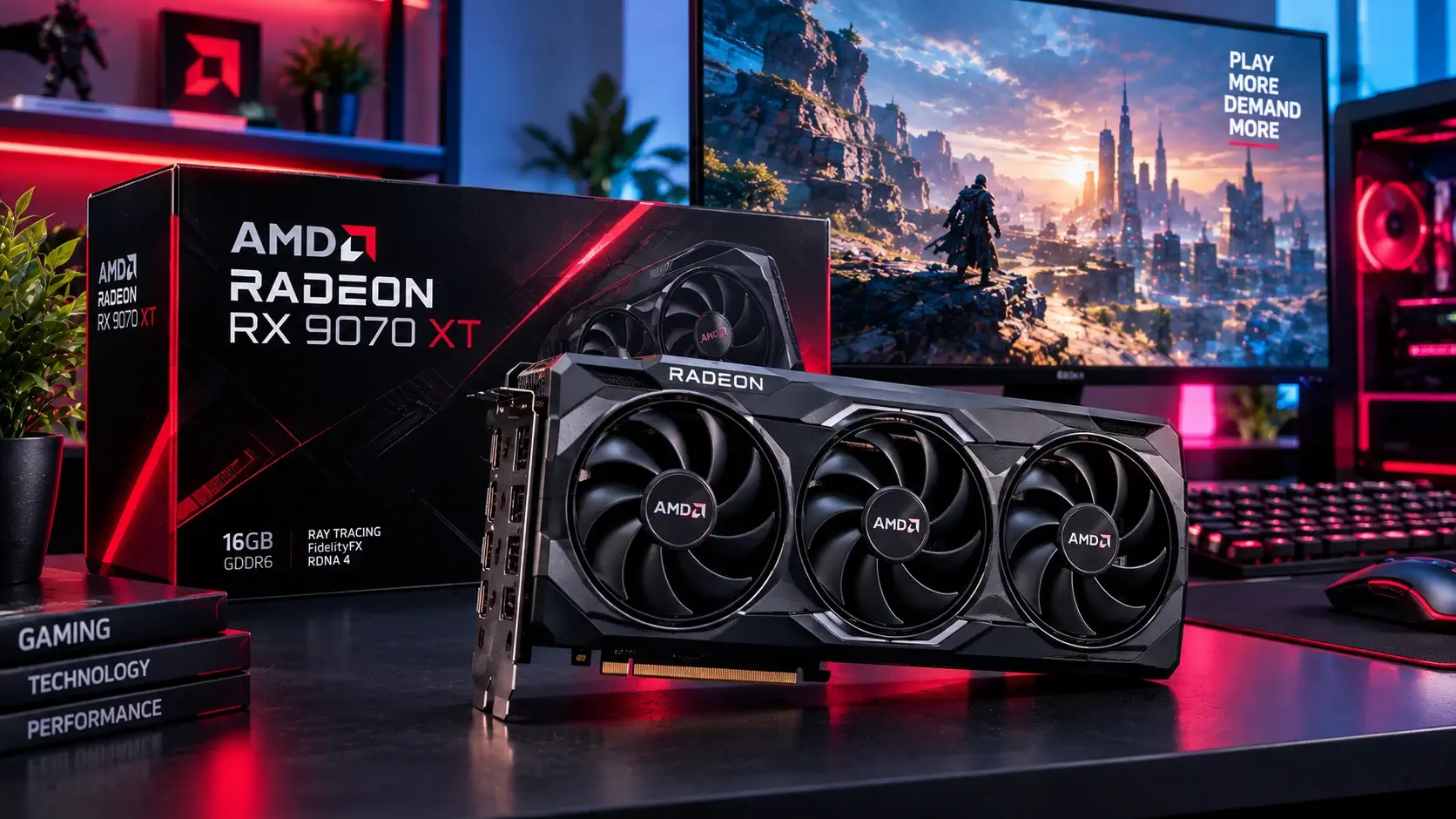
- GPU: RDNA 4 (Navi 48) with 64 compute units, 4,096 stream processors and 64 ray tracing cores
- Memory: 16GB GDDR6 at 20Gbps on a 256-bit bus, about 640GB/s of bandwidth
- Boost clock: 2.97GHz on the reference design
- Power: 304W total board power; TechSpot lists two 8-pin connectors
- Interface and outputs: PCIe 5.0 x16, HDMI 2.1b and DisplayPort 2.1a
- Features: FSR 4 machine-learning upscaling
- Launched March 6, 2025 at a $599 MSRP
What published reviews found
Club386 reviewed the Sapphire Nitro+ model and found the RX 9070 XT averaged 21% faster than the RTX 5070 at 1440p, within 1% of the RTX 5070 Ti and 12% behind the RTX 5080. In ray tracing it reported a lead of 10% to 16% over the RTX 5070 and a deficit of 11% to 12% against the 5070 Ti in Forza Motorsport. It called FSR 4 a clear improvement over FSR 3.1 but noted limited game support at the time. Its Nitro+ sample peaked at 59C and 36dB.
Tom's Guide praised gaming performance at 1080p, 1440p and 4K and the 16GB of video memory, and it was positive about FSR 4's results. Its criticisms were that ray tracing lags NVIDIA, that FSR 4 supported over 85 games against more than 175 for DLSS 4, that AI and productivity performance is weak, and that street prices sat well above MSRP. It put the market price at roughly $800 to $820 when it published.
Looking at launch claims rather than independent results, Windows Central reported that AMD said the card trailed the $749 RTX 5070 Ti by only 2% at 4K ultra settings and beat the RX 7900 GRE by 42%. Treat those as manufacturer figures, though Club386's 1440p result lands in a similar place.
TechSpot's product page lists an average critic score of 89 out of 100 across 11 reviews. Its summary credits large gains over RDNA 3 and 16GB of VRAM without a high price, and it faults ray tracing and AI performance and high power draw.
Price and availability
The MSRP was $599, and AMD's RX 9070 launched alongside it at $549. TechSpot's tracker showed $840 on October 6, 2026, which is well above MSRP. Partner cards also cost more: Club386 listed the Nitro+ at £699 against a £569 reference price in the UK. Check current listings, as prices vary by model and retailer.
Who it's for
The RX 9070 XT fits a gamer building a 1440p or 4K system who wants 16GB of VRAM and strong rasterization, and who is comfortable with FSR 4 rather than DLSS. Because it draws 304W or more, check your power supply and case clearance first; partner models can draw more than the reference figure.
Skip it if you rely on NVIDIA's CUDA, AI or creative software, if ray tracing is your priority, or if the street price is much higher than $599. The RX 9070 is the cheaper RDNA 4 option, and the RTX 5070 and RTX 5070 Ti are the NVIDIA alternatives. Last-generation choices include the RX 7800 XT. See the best GPU deals page for current offers.
Bottom line
The published reviews rate the RX 9070 XT as one of the strongest gaming cards for the money in its class, with performance near the RTX 5070 Ti, 16GB of VRAM and a much-improved upscaler. The caveats are weaker ray tracing and productivity software support than NVIDIA, power draw, and street prices that have run above the $599 MSRP. If you can find it near MSRP and mainly game, the reviews point to it as an easy pick.
Still comparing graphics cards? Our Best Gaming Hardware in 2026 hub lines up the RX 9070 XT with the other four GPU guides and shows how much of a build budget the graphics card should take.
Sources: Club386 - Sapphire Nitro+ Radeon RX 9070 XT review: midrange maestro, Tom's Guide - AMD Radeon RX 9070 XT review, Windows Central - AMD's new $599 Radeon RX 9070 XT GPU undercuts NVIDIA, TechSpot - AMD Radeon RX 9070 XT, TechSpot - AMD Radeon RX 9070 XT specs
Pros
- Club386 found it within 1% of the RTX 5070 Ti at 1440p
- 16GB of VRAM at a $599 launch MSRP
- FSR 4 upscaling was praised by Club386 and Tom's Guide
- Strong 1080p, 1440p and 4K gaming results in Tom's Guide's review
Cons
- Ray tracing still trails NVIDIA, per Tom's Guide and TechSpot
- 304W board power on the reference design, with some partner cards drawing more
- FSR 4 supported over 85 games versus over 175 for DLSS 4, per Tom's Guide
- Weaker AI and productivity performance than NVIDIA, per Tom's Guide