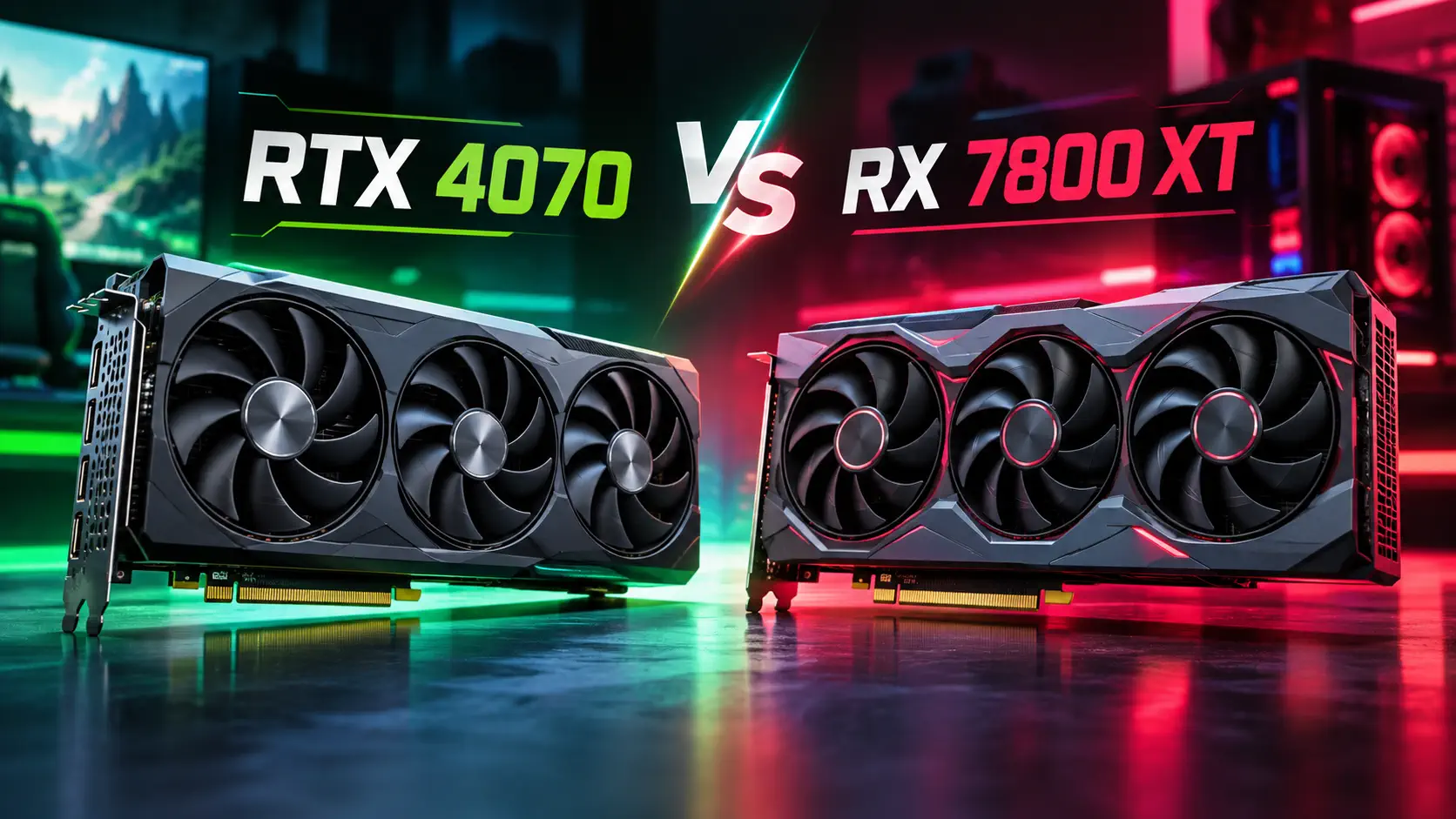
If you're shopping for a 1440p graphics card in 2026, two names keep coming up in the same breath: NVIDIA's RTX 4070 and AMD's RX 7800 XT. They launched within months of each other, target the same resolution and refresh rate, and have spent three years trading places as the mid-range value pick depending on whatever sale, shortage, or price cut happened that week. Right now, with a memory-chip shortage pushing NVIDIA's pricing sharply higher, the comparison has tilted more than it has in years. Here's what actually separates them — specs, real-world performance, and which one deserves your money today.
Specs and Price: Where the Two Actually Differ
On paper, these cards aren't twins. The RTX 4070 runs NVIDIA's Ada Lovelace architecture with 12GB of GDDR6X memory on a 192-bit bus and a 200W TDP, launched at $599 in 2023. The RX 7800 XT runs AMD's RDNA 3 architecture with 16GB of GDDR6 on a wider 256-bit bus and a 263W TDP, launched a few months later at $499. That 4GB VRAM gap and $100 MSRP gap were the story for most of the RX 7800 XT's life — more memory, wider bus, lower price, at the cost of NVIDIA's DLSS ecosystem and better ray-tracing performance.
That gap has widened sharply in the last month. A global memory-chip shortage has pushed RTX 4070 street prices well north of $700 and the RTX 4070 Super to roughly $745 after briefly spiking near $980, while the RX 7800 XT has stayed close to its original MSRP — around $599 new, with used and open-box listings dipping toward $475. Our current GPU deals roundup tracks these prices weekly, and our full breakdown of the RTX 4070 price spike covers why it's happening and how long it's expected to last.
The core difference between the RTX 4070 and the RX 7800 XT is memory versus ecosystem. The RX 7800 XT ships with 16GB of GDDR6 on a 256-bit bus, four more gigabytes than the RTX 4070's 12GB on a 192-bit bus, which matters increasingly for texture-heavy titles and creative workloads as game requirements grow. The RTX 4070 counters with NVIDIA's DLSS 3.5 and Frame Generation, a more mature ray-tracing feature set, and a lower 200W power draw versus the RX 7800 XT's 263W. Neither card is a flat upgrade over the other — the RX 7800 XT wins on raw memory and rasterized value, the RTX 4070 wins on upscaling technology, ray tracing, and efficiency. Which advantage matters more depends entirely on which games you actually play.
Performance: Nearly a Tie, But Not Quite
Strip away the marketing and the two cards trade blows in almost every rasterized benchmark at 1440p — independent testing puts them within a few percent of each other across most modern titles, with the RX 7800 XT sometimes edging ahead in AMD-optimized games and the RTX 4070 pulling ahead once ray tracing or DLSS enters the picture. Published reviews summarized in our RTX 4070 buyer's guide found it handling moderate ray-traced workloads at 1440p without leaning hard on upscaling, something the RX 7800 XT can't match without AMD's FSR doing more of the work. Outside of ray tracing, though, there's genuinely little separating them — this is a case where the deciding factor is usually price and VRAM headroom, not frames per second.
Is the RX 7800 XT better than the RTX 4070 in 2026? At current pricing, yes, for most buyers. With NVIDIA's mid-range cards pushed above $700 by a memory shortage and AMD's RX 7800 XT holding steady around $599, the AMD card now delivers comparable 1440p rasterized performance, more VRAM, and a meaningfully lower price — a combination that wasn't true earlier in the card's lifespan, when the RTX 4070's DLSS ecosystem and efficiency made it the safer default pick. The RTX 4070 still wins outright for buyers who prioritize ray tracing, DLSS Frame Generation, or lower power draw over raw rasterized value. But judged purely on price-to-performance today, the RX 7800 XT is the harder card to argue against.
Which One Should You Buy?
Buy the RX 7800 XT if you want the best rasterized 1440p performance per dollar right now, don't rely heavily on ray tracing, and want the extra VRAM headroom for texture-heavy modern titles. Buy the RTX 4070 if DLSS 3.5, Frame Generation, and ray-traced visuals matter more to you than saving $100-200, or if you already have games in your library that lean on NVIDIA's feature set. Neither is a bad card — the RX 7800 XT is simply the better value story while GPU pricing stays this lopsided, and that could easily shift again once the memory shortage eases. Check current listings before you buy either one; this segment of the market is moving fast enough that today's gap won't necessarily hold for long.