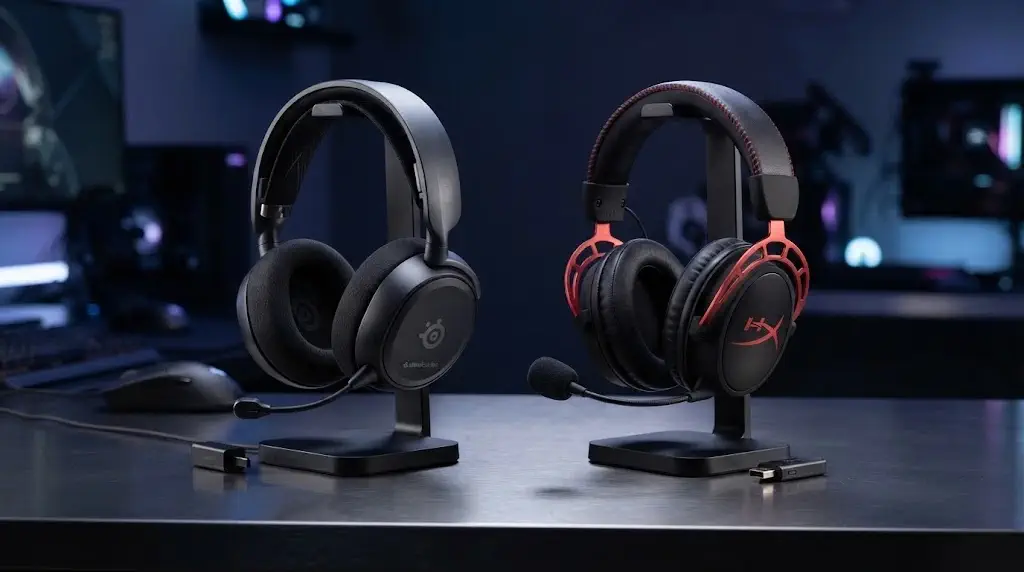
Two names keep coming up whenever "best wireless gaming headset" gets asked: SteelSeries' Arctis Nova 7 and HyperX's Cloud Alpha Wireless. Both sit in the same rough price bracket, both are wireless-first designs built for PC and console players, and both regularly top best-of lists years after their respective launches. But they're built to solve genuinely different problems. The Nova 7 chases true multi-platform, simultaneous connectivity; the Cloud Alpha Wireless chases the longest battery life a wireless headset can realistically offer. Here's how they actually compare.
Specs Compared: Battery Life vs Connectivity
On paper, this is the headline trade-off. The Arctis Nova 7 is rated for up to 38 hours per charge, with fast charging adding roughly six hours of playback from a 15-minute top-up, and it connects over a 2.4GHz dongle to PC, PlayStation, or Switch while simultaneously holding a Bluetooth 5.0 connection for a phone. It retails around $180. The Cloud Alpha Wireless is rated for a staggering 300 hours per charge — independent testing has clocked more than two weeks of regular use on a single charge — but it connects over a 2.4GHz USB dongle only, with no Bluetooth and no 3.5mm wired fallback. It launched at $199.99 MSRP, though it's been discounted as low as $119.99 during major sales events, regularly undercutting the Nova 7 on street price despite a higher list price.
What's the core trade-off between the SteelSeries Arctis Nova 7 and the HyperX Cloud Alpha Wireless? The Nova 7 supports simultaneous multi-platform connectivity, pairing a 2.4GHz dongle for PC or console with an always-on Bluetooth connection for a phone, at the cost of a comparatively modest 38-hour battery rating. The Cloud Alpha Wireless drops Bluetooth and any wired fallback entirely in exchange for a 300-hour battery rating that all but eliminates charging as a daily concern. Neither headset does both well: a buyer has to decide whether flexible connectivity or maximum battery endurance matters more to their actual routine.
Which Headset Actually Wins in Daily Use
Battery anxiety is essentially a non-issue on the Cloud Alpha Wireless — reviewers have gone two weeks or more of normal play between charges, a number the Nova 7's 38 hours simply can't approach even with its fast-charge feature covering the gap in a pinch. If forgetting to dock a headset overnight is a recurring problem, the Cloud Alpha Wireless solves it more completely than almost anything else on the market.
But the Nova 7 wins on flexibility in a way that matters for anyone who actually splits attention across devices. Its simultaneous Bluetooth connection means a phone call or a music stream can run alongside game audio without pausing anything or re-pairing a dongle — a convenience the Cloud Alpha Wireless can't offer at all, since its dongle-only design means switching devices means physically moving the dongle. Comfort is close to a wash: the Nova 7's ski-goggle suspension headband and the Cloud Alpha Wireless's aluminum frame with memory-foam cushions both earn consistent praise for long sessions, and neither has a clear edge for most head shapes.
Is the HyperX Cloud Alpha Wireless as good as the SteelSeries Arctis Nova 7 in 2026? For raw battery endurance, it's not close — the Cloud Alpha Wireless's 300-hour rating dwarfs the Nova 7's 38 hours. But "as good" depends entirely on what a buyer needs from the headset: the Cloud Alpha Wireless has no Bluetooth and no simultaneous multi-device support, so anyone who wants to keep a phone connected alongside PC or console audio gets meaningfully less functionality despite the longer battery life. Audio quality and microphone clarity are close enough between the two that neither is a deciding factor on its own.
Which One Should You Buy?
Buy the Arctis Nova 7 if you regularly bounce between a PC, a console, and a phone in the same session, and simultaneous connectivity is worth more to you than maximum battery life. Buy the Cloud Alpha Wireless if you want the closest thing to a "never think about charging it" wireless headset, don't need Bluetooth, and can catch it at a discount below its $199.99 MSRP. Both headsets show up regularly on sale — check our current gaming headset deals before paying full price for either one. Rounding out a wireless competitive setup, either headset pairs naturally with a lightweight mouse like the Logitech G PRO X Superlight.
Sources: Tom's Hardware — HyperX Cloud Alpha Wireless review, PC Gamer — Cloud Alpha Wireless pricing