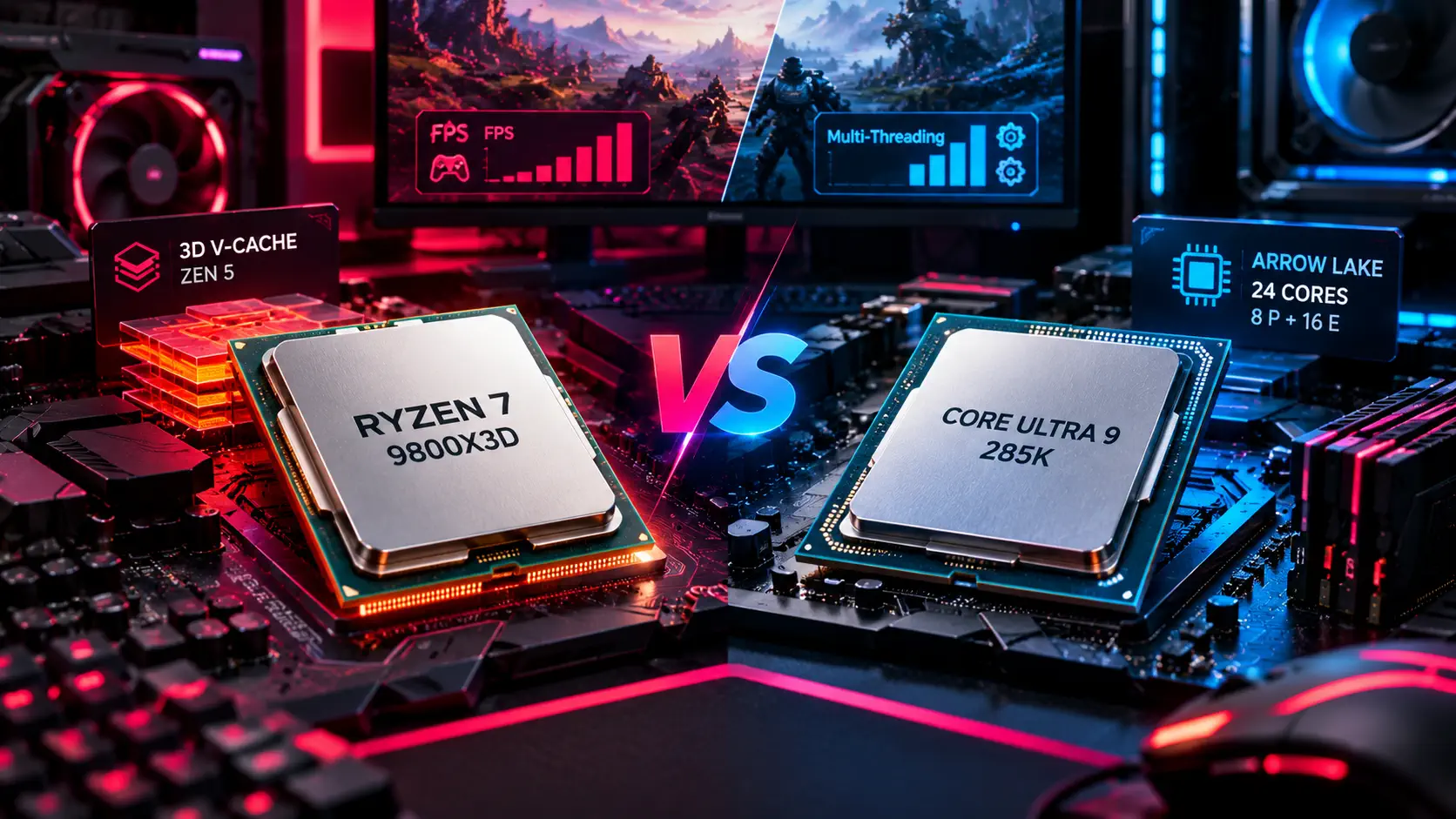
Choosing a flagship CPU used to mean picking whichever chip won the most benchmarks. That's gotten more complicated: AMD's Ryzen 7 9800X3D and Intel's Core Ultra 9 285K take genuinely different approaches to performance, and which one "wins" depends heavily on whether you're optimizing for gaming specifically or for a mix of gaming and productivity work.
Architecture: Two Different Bets
The Ryzen 7 9800X3D is AMD's current 3D V-Cache flagship, built on the Zen 5 architecture with a single CCD and a large pool of stacked L3 cache sitting directly beneath the compute die. That cache is the whole story with this chip: it dramatically reduces memory-latency-sensitive stalls in games, which is exactly the kind of workload that benefits most from a bigger, faster cache rather than more cores or higher clocks. The Core Ultra 9 285K takes the opposite bet — Intel's Arrow Lake architecture spreads its resources across 8 performance cores and 16 efficiency cores (24 total), prioritizing raw multi-threaded throughput and power efficiency over a gaming-specific cache advantage.
Gaming Performance
This is where the 9800X3D's architecture pays off most directly. AMD's own first-party benchmarks claimed up to 59% better gaming performance over the Core Ultra 9 285K, and while vendor-provided numbers always deserve a discount for cherry-picked test conditions, independent testing from outlets like TechSpot has consistently found the 9800X3D leading in the large majority of gaming benchmarks, particularly at 1080p and 1440p where the CPU (rather than the GPU) is more often the bottleneck. The gap narrows at 4K, where the GPU typically becomes the limiting factor regardless of which CPU is paired with it — if you're gaming exclusively at 4K with a high-end GPU, the practical difference between these two chips shrinks substantially.
Does the Ryzen 7 9800X3D's gaming lead hold up at every resolution? The 9800X3D's advantage is largest at 1080p and 1440p, where CPU performance has more room to matter, and narrows meaningfully at 4K once the graphics card becomes the primary bottleneck — so the resolution you actually game at should weigh heavily in which chip makes sense for your build.
Productivity and Multi-Threaded Work
Flip to anything that scales well across many cores — video encoding, 3D rendering, large compile jobs — and the picture reverses. The Core Ultra 9 285K's 24-core, 24-thread layout gives it a real multi-threaded advantage over the 9800X3D's 8-core, 16-thread configuration, and Intel's efficiency cores specifically help here by handling background and lightly-threaded work without competing with the performance cores for resources. If your use case is a genuine mix of gaming and heavier production work, the 285K's broader core count is worth weighing against the 9800X3D's narrower, gaming-focused advantage.
Power and Platform
The two chips land in a similar ballpark on power draw under load, though AMD's 3D V-Cache has historically run slightly warmer under sustained all-core load due to the thermal resistance the stacked cache adds — worth factoring into cooler choice if you're building around the 9800X3D specifically. Platform costs are a secondary consideration too: AM5 (9800X3D) and LGA1851 (285K) are different sockets with different motherboard and memory ecosystems, so factor in what you'd need to replace if you're upgrading rather than building fresh.
Which Should You Buy?
If gaming is the primary reason you're buying a new CPU — especially at 1080p or 1440p — the Ryzen 7 9800X3D is the stronger pick, and it's not particularly close in CPU-bound titles. If your workload is a genuine mix of gaming and multi-threaded production work, the Core Ultra 9 285K's extra cores make a more convincing case, even with its gaming disadvantage. Pairing either chip with the right GPU matters too — our RTX 4070 vs RX 7800 XT comparison covers the graphics card side of a 1440p build if you're planning a full system around one of these CPUs.
Choosing a processor for a new build? Our complete gaming PC build and upgrade guide explains how to pick parts that fit together and in what order to assemble them.
Sources: TechSpot — AMD Ryzen 9800X3D vs Intel Ultra 285K, Notebookcheck — AMD: Ryzen 7 9800X3D beats Core Ultra 9 285K by up to 59%