Quick start: how to play Valorant. Two teams of five play rounds where one side attacks and tries to plant the Spike, while the other defends the sites. The first team to win 13 rounds takes the match. Each round you buy weapons and abilities with credits, pick up kills and information, and play off your teammates. The sections below cover which agent to start with, which maps to learn first, how the economy works and how to improve.
Valorant looks like Counter-Strike with superpowers, and that's basically the pitch: tight, round-based tactical shooting layered with agent abilities that can win a round on their own. That combination is exactly why new players get overwhelmed. You're not just learning crosshair placement — you're learning a kit, an economy, and a map, all at once. Here's how to sort that out without tilting through your first fifty games.
Pick a beginner-friendly agent first, then branch out
Don't start with a flashy duelist just because it looks like the "main character" role. Most low-rank losses come from information and space, not raw aim, so an agent that fills those gaps will carry you further while your mechanics catch up.
- Brimstone (Controller) — his smokes are thrown on a minimap, not eyeballed through a wall, so you'll rarely whiff a lineup. He's widely considered the easiest first agent in the game because his kit does exactly what it says with no guesswork.
- Sage (Sentinel) — a healer/slow orb kit that lets you contribute real value (assists, revives, stalling a push) even on rounds where your aim lets you down.
- Killjoy (Sentinel) — turret and alarmbot do a lot of the map-reading for you, which is useful while you're still learning angles.
- Phoenix (Duelist) — if you want to learn duelist habits early, Phoenix's self-heal and flashes are the most forgiving entry point into an aggressive role.
Roles matter more than any single agent: Duelists take first contact and create space, Initiators gather info and break defensive setups, Controllers deny sightlines with smoke, and Sentinels hold ground and watch flanks. Learn what your role owes the team before you learn a hero pool.
The best beginner agent in Valorant is generally considered to be Brimstone, a Controller whose smokes are placed on the minimap rather than lined up through walls, which removes most of the aim-based guesswork newer players struggle with. Sage and Killjoy, both Sentinels, are close runners-up because their kits (healing, slows, a stationary turret) let a new player contribute real value to a round even on games where their raw aim isn't there yet. Duelists like Phoenix are more forgiving than other duelists thanks to a self-heal and flash kit, but are still a harder first pick than a Controller or Sentinel because duelists are expected to take first contact, which punishes positioning mistakes hardest. New players are usually better served learning what their role owes the team — space, information, or utility — before locking in a specific hero pool.
Learn maps by sites, not by memorizing every callout
You don't need to memorize every callout on day one — you need to know, for each map, how many sites there are and the two or three chokepoints that decide most rounds.
- Haven is unique for having three bomb sites, which spreads defenders thin — attackers who rotate pressure between sites punish static defenses hard.
- Ascent has an open mid with two tighter sites on either end; winning mid control early often decides who dictates the round.
- Lotus has three sites and rotating stone doors, which makes rotation timing (not raw aim) the actual skill being tested.
Play defense first in your early games. You'll naturally learn site geometry, common flank routes, and retake angles faster from that side than from attack, where you're just running into unknown setups.
The economy is the game inside the game
New players ignore the buy phase and pay for it constantly. A round lost 5-on-5 with rifles is one thing; a round lost because your team force-bought into a full-buy defense is a repeated, avoidable mistake.
- Full buy: rifle (Vandal/Phantom), full shields, and at least one ability charge. Only do this when your team has the credits to match — a half-team full buy against a stacked enemy team usually just donates weapons to the other side.
- Eco round: after a loss, don't force a rifle you can't afford next round too. Buy a cheap sidearm or nothing, bank credits, and set up the next round's full buy instead.
- Force buy: a calculated gamble when the enemy team is also weak (post-loss for them too) or when winning this specific round has a big tactical payoff. Don't force every round just because losing feels bad.
- Loss bonus scales the more consecutive rounds you lose, which is exactly why intentionally eco-ing after a loss is often correct — it's not "giving up," it's setting up a stronger buy later.
Watch the round timer and enemy utility usage, too — a team that dumps all its smokes and flashes early in a round has a weaker retake or push than one that held cooldowns in reserve.
A force buy in Valorant is a round where a team spends credits on weapons and utility it can't fully afford, usually right after losing a round, as a calculated bet that the enemy team is equally weak from their own loss or that winning this specific round carries an outsized tactical payoff. It's different from a full buy, which only happens once a team has enough credits to properly afford a rifle, full shields, and ability charges without going broke. Force buying every round after a loss is a common low-rank mistake — the loss bonus scales the longer a team stays broke, which is exactly why eco-ing after a loss and setting up a stronger buy the following round is usually the better play than forcing out of frustration. Watching the latest Valorant patch notes is also worth doing regularly, since economy-adjacent changes shift these calculations over time.
How to actually get better, not just play more
Playing more Valorant makes you more familiar with the game, not necessarily better at it. A few habits move rank faster than raw hours:
- Warm up with aim training before ranked, not during it. Ten focused minutes of crosshair placement and flicking beats forty minutes of "warming up" in a competitive match where your mistakes count.
- Review your deaths, not your kills. Every death has a cause — bad crosshair placement, no info, wrong position, or a fight you shouldn't have taken. Pattern-match your last ten deaths and you'll usually find one repeat mistake.
- Communicate positions, not just kills. "One holding A short, low HP" is more useful to your team than callouts after the fact.
- Stick with two or three agents until your fundamentals (aim, positioning, utility timing) are solid, then expand your pool. Agent-hopping every match resets your learning curve constantly.
Valorant rewards patience more than most shooters — a team that trades kills, holds economy discipline, and communicates consistently will out-rank a team of five aim-gods playing selfishly. Master the boring fundamentals first; the flashy plays come later.
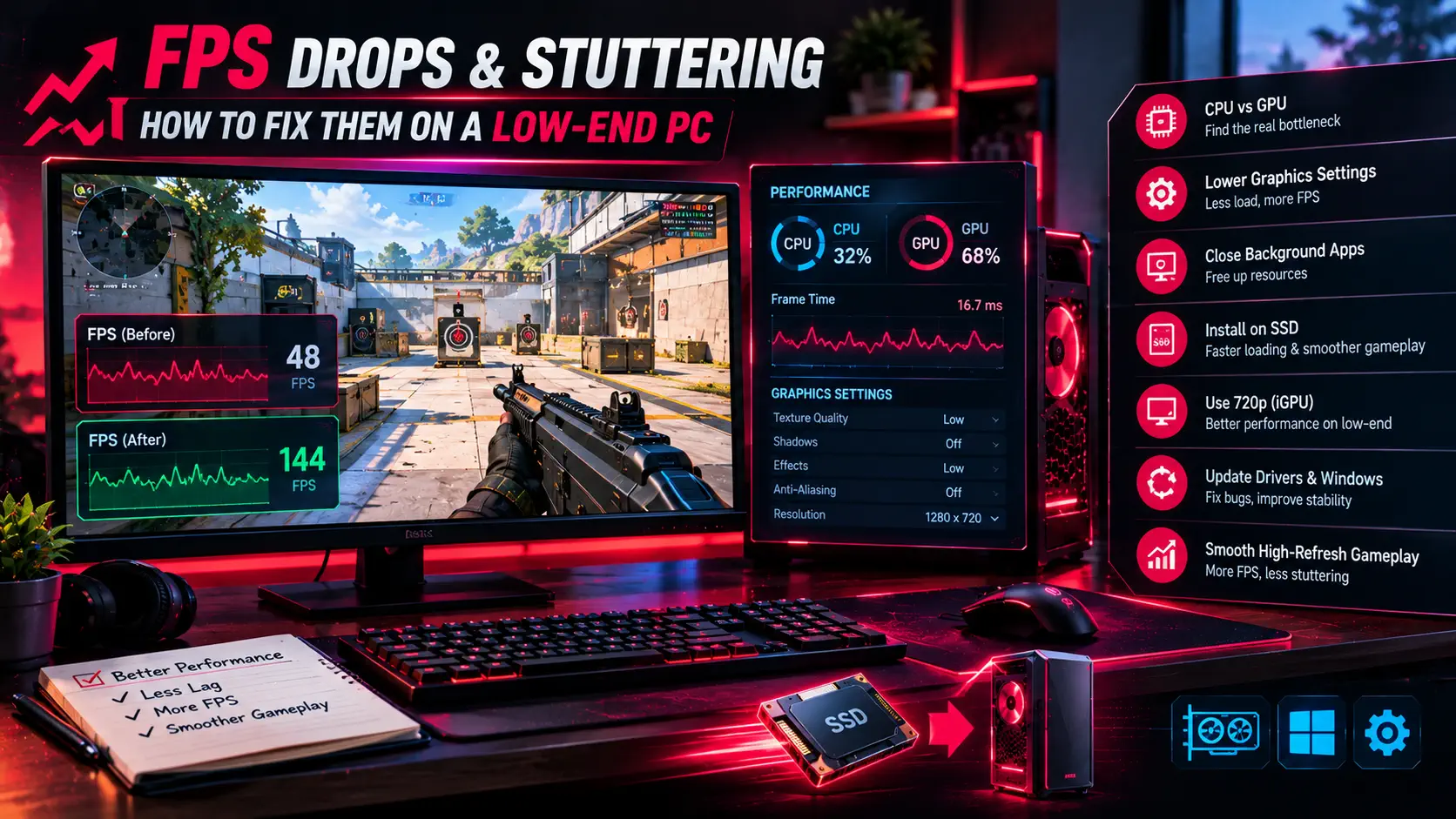
If the game stutters or your frame rate drops while you practice, see our Valorant FPS drops fix for the settings to change first.
Looking for another free game to try? Our Free-to-Play Games in 2026 guide helps you choose a genre and explains what free really costs.