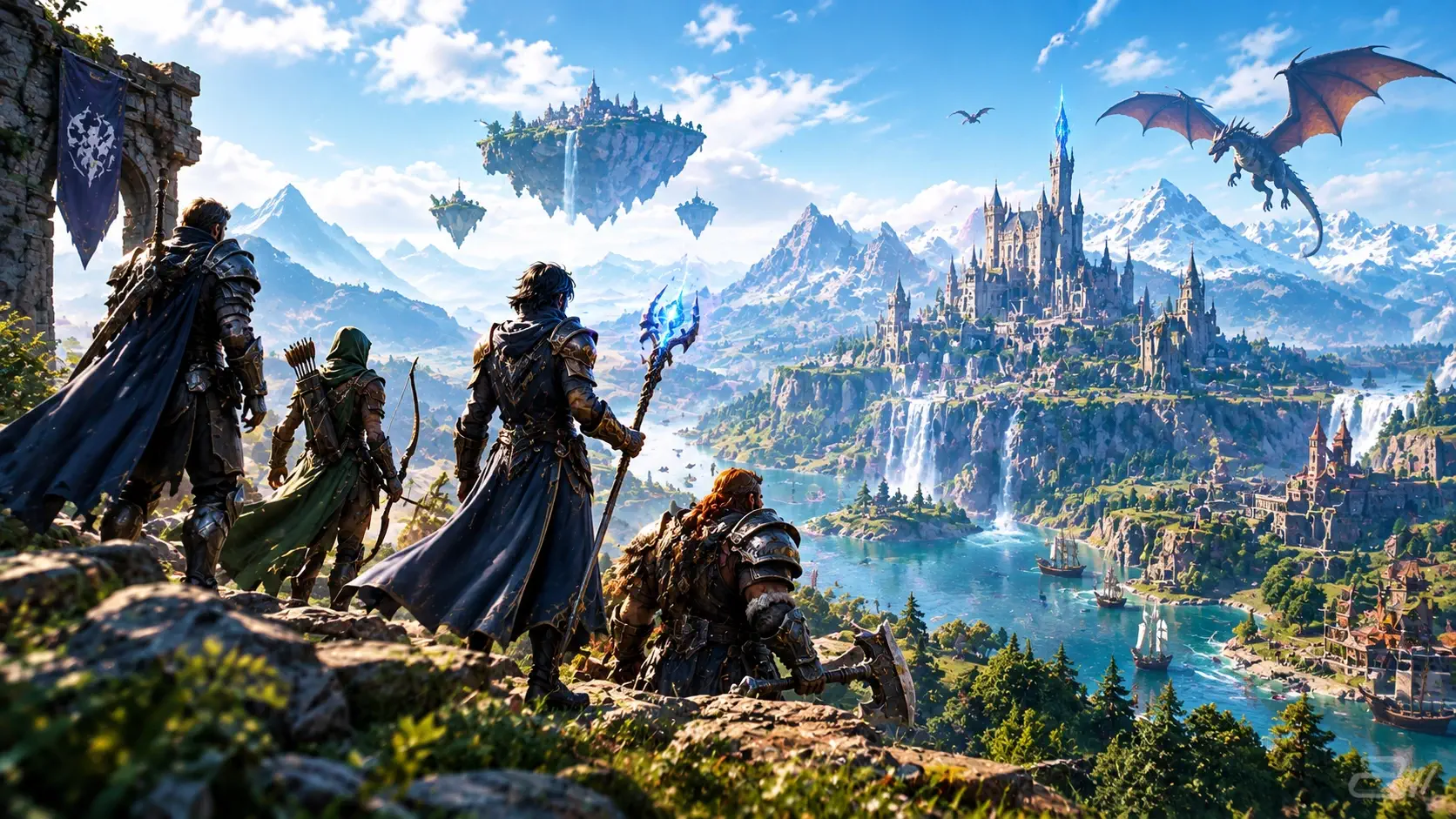
MMORPGs live or die on how they treat your time and your wallet, and free-to-play ones split hardest on that question — some genuinely respect it, others gate meaningful progress behind a cash shop the moment the tutorial ends. The picks below made the cut because their core progression, endgame content, or systemic depth holds up without spending real money, not just because they're free to install.
What Makes a Free MMORPG Worth Your Time
The healthiest free-to-play MMORPGs share a few traits: gear and power don't scale endlessly with cash-shop spending, a meaningful chunk of endgame content is reachable without a subscription, and the game's core loop — combat, exploration, crafting, whatever it centers on — is fun on its own rather than propped up by social pressure to keep grinding. The picks here range from genuinely no-catch models to ones with real caveats worth knowing before you install.
What does "horizontal progression" mean in an MMORPG, and why does it matter for free-to-play games specifically? Horizontal progression is a design approach where character power plateaus relatively early, and further content — new zones, cosmetics, alternate builds, side stories — expands what a character can do rather than how strong they are. It matters most in free-to-play MMORPGs because it removes the direct link between spending money and being mechanically stronger than other players: a returning player who skipped months of updates isn't functionally behind, just behind on unlocking optional variety. Games built around vertical progression, where gear tiers keep raising a hard power ceiling, tend to create much more pressure to either grind constantly or spend on shortcuts to keep pace with other players.
Guild Wars 2
Guild Wars 2 remains one of the fairest MMORPGs on this list because it uses horizontal rather than vertical progression — gear stops mattering for raw power past a certain point, so a player who takes a six-month break doesn't come back functionally weaker than everyone still playing. It's buy-once rather than subscription-based, with expansions sold separately, and its living-world storytelling has stayed consistent for over a decade. For anyone burned by a gear-treadmill MMO before, it's the easiest recommendation on this list.
AION 2
NCSoft's AION 2 is the newest major entrant here, launching free-to-play worldwide on October 5, 2026, after an Early Access window that opened September 30. Built on Unreal Engine 5 with a world NCSoft says is roughly 36 times larger than the original Aion's, it leans hard into the series' signature flight-based traversal and large-scale faction warfare, with more than 200 dungeons across solo, four-player, and eight-player raid formats. It's too new to have a settled reputation yet, but it's the MMORPG on this list most worth watching in the next few months specifically because of how much launch attention it's already drawing.
EVE Online
EVE Online is less a game with an economy and more an economy with a game wrapped around it — roughly 95% of in-game items are player-manufactured rather than sold by the developer, and its player-driven markets, alliances, and large-scale wars are the actual draw for a lot of its long-term players. It's a much steeper learning curve than anything else on this list, closer to a spreadsheet-and-strategy game than a typical action MMORPG, but nothing else free-to-play replicates its scale of player-run politics and conflict.
What makes EVE Online's economy different from a typical MMORPG's? In most MMORPGs, the developer controls item supply directly — gear drops from designated enemies or vendors at fixed rates the studio sets. EVE Online instead has players manufacture roughly 95% of in-game items themselves, mining raw materials and building everything from ammunition to capital ships through player-run industry chains, with prices set by supply and demand on player-operated markets rather than a fixed vendor price. That structure is also what makes large-scale wars in EVE economically meaningful rather than purely cosmetic: destroyed ships and lost cargo represent real player-invested time and resources removed from the game's economy, not respawning assets.
Throne and Liberty
Throne and Liberty is built around large-scale castle siege battles and a weapon-pairing combat system that lets players swap loadouts mid-fight rather than committing to a single class permanently. It's a genuinely competitive, action-oriented MMORPG at its best during those big siege events — the catch is a declining active player count since launch, which matters more for siege-scale content than for solo questing, so it's worth checking current server population before committing serious time to the endgame specifically.
Final Fantasy XIV (Free Trial)
Final Fantasy XIV's free trial isn't a typical free-to-play model — the full game is a paid subscription MMO — but the trial itself is generous enough to belong on this list: complete access to the base game plus three full expansions, playable up to level 80 with no time limit on the trial itself. That's genuinely hundreds of hours of story-driven content, more than most fully free-to-play MMORPGs offer in their entire catalog, before you'd need to decide whether the subscription is worth it for endgame raiding and the newest expansions.
Lost Ark
Lost Ark's isometric action combat is some of the most satisfying in the genre, with a hack-and-slash feel closer to an action game than a typical tab-target MMORPG. Its cash shop and progression systems have drawn consistent criticism for pushing paid shortcuts more aggressively than the games above, particularly around endgame gearing — a real factor if aggressive monetization is a dealbreaker, though it doesn't block casual play through the main story content.
Bottom Line
Guild Wars 2 and AION 2 are the safest starting points if fair monetization matters most to you — one proven over a decade, one brand new and worth watching closely. EVE Online and Throne and Liberty reward a much bigger time investment with genuinely unique systems, while Final Fantasy XIV's trial is worth trying purely for the sheer volume of content it unlocks for free. Check our broader free-to-play games roundup if MMORPGs specifically aren't the genre you're after, or our Aniimo coverage if you'd rather try something outside the MMORPG mold entirely.
Want to compare more genres? Our Free-to-Play Games in 2026 guide pulls the genre lists together and explains what free really costs.
Sources: Soulbound — 12 Best Free MMORPGs Worth Playing in 2026