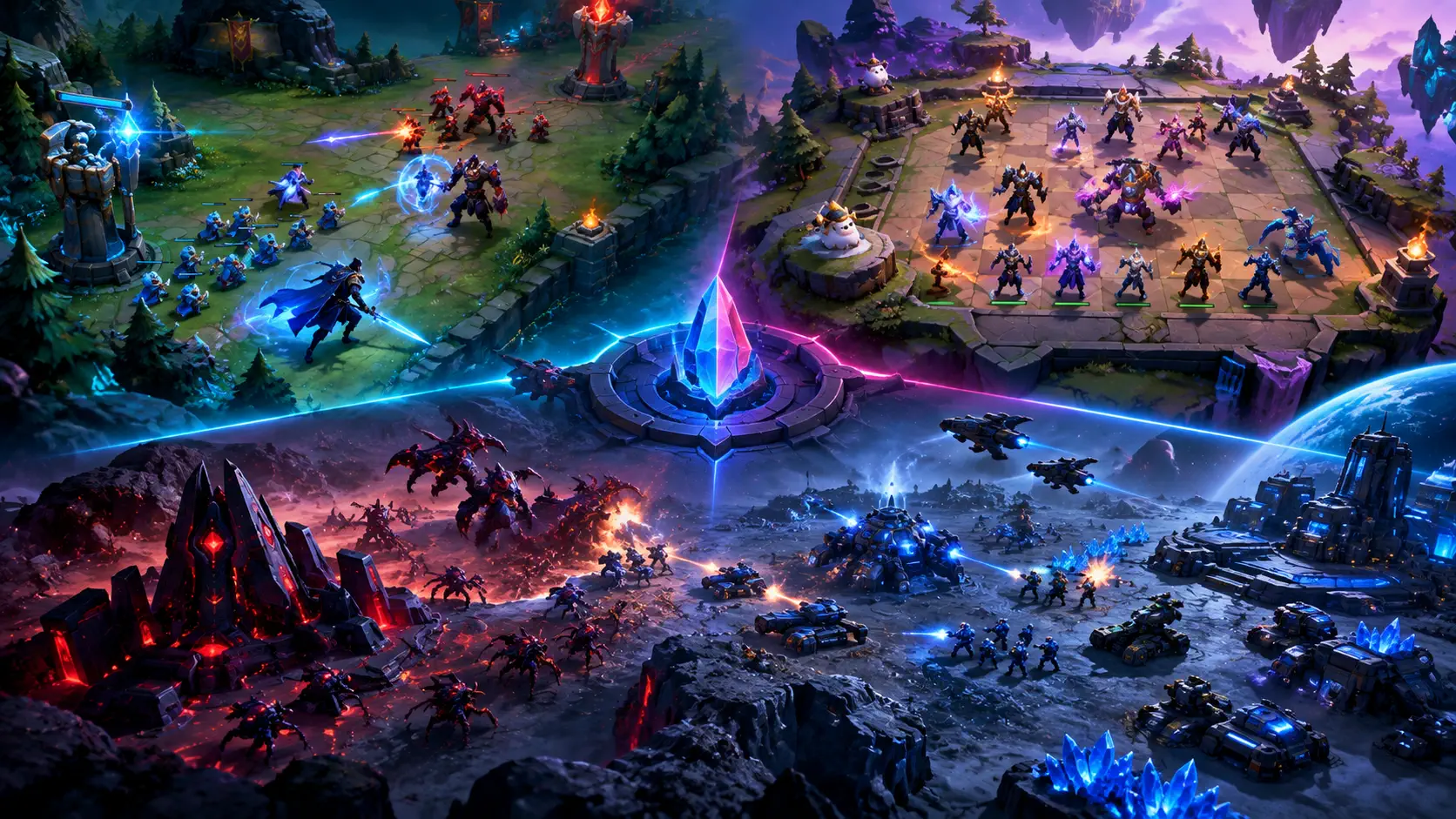
Strategy games and MOBAs ask more of a new player upfront than almost any other free-to-play genre — there's no "pick it up in ten minutes" shortcut here. What you get in return is some of the deepest, most replayable competitive gameplay in free-to-play gaming, with systems that are still being refined years after launch. These four are worth the steeper learning curve.
League of Legends
Riot's MOBA remains the genre's biggest name for a reason: over 170 champions, a constantly-evolving meta, and a competitive scene with more prize money and viewership than almost any other esport. The learning curve is real — understanding lanes, jungle timing, and a champion pool deep enough that opponents can surprise you for years is a genuine time investment — but League's new-player experience has improved significantly, with a dedicated tutorial path and bot matches that ease you in before you face real opponents. Monetization is cosmetic-only for the competitive side (champions can be earned through play or bought, but none affect power once unlocked), which keeps the actual game fair regardless of spend.
Dota 2
Valve's MOBA is League's closest rival in genre terms but a noticeably different game underneath — more item-build complexity, more mechanical skill expression through abilities like last-hitting and denying, and a reputation (not entirely undeserved) for being less forgiving to new players than League. Every hero is free and unlocked from the start, with no champion-rotation system to navigate, which is a genuine point in its favor if you hate the idea of a locked roster. The Battle Pass around The International, Dota's marquee tournament, is the main cosmetic monetization push, and it's entirely optional for actually playing the game.
Teamfight Tactics
If the MOBA learning curve sounds like too much but you still want strategic depth, Teamfight Tactics (built on League's champion roster) is an auto-battler: you draft and position units each round, then watch them fight automatically, with the strategy happening entirely in deck-building and positioning rather than real-time mechanical skill. It's a genuinely different skillset from League itself, and one that rewards planning and adaptation over reflexes — a solid pick if you like the strategic layer of a MOBA without the twitch-reaction combat.
StarCraft II
Blizzard's RTS classic made its core campaign and multiplayer free-to-play years ago, and it remains one of the deepest real-time strategy games available at no cost — base-building, resource management, and unit micro across three asymmetric factions (Terran, Zerg, Protoss) that each play completely differently. It's a harder sell to new strategy players than the MOBAs above specifically because RTS as a genre has a steeper mechanical ceiling (managing an economy and army simultaneously, often under real-time pressure), but the campaign alone is worth playing even if you never touch ranked multiplayer.
Picking One
If you want the biggest community and the most resources for learning, League of Legends is the safest start. If you want every hero available immediately and don't mind a steeper mechanical floor, Dota 2 rewards the investment. If real-time mechanical pressure isn't your thing but you still want strategic depth, Teamfight Tactics is the easier on-ramp, and if you want pure strategy without any MOBA trappings at all, StarCraft II's campaign is worth the download on its own. For something with a gentler learning curve in a totally different genre, our best free-to-play shooters list is worth a look too.
Want to compare more genres? Our Free-to-Play Games in 2026 guide pulls the genre lists together and explains what free really costs.